
Clearwater Lakes Information
CRC continues to build on this information through yearly work by staff, volunteers, and observations by area residents and visitors. Thank you to everyone who has contributed.
To learn about what CRC is and has been doing in regards to the monitoring of the water in our area lakes click here.
learn more about Various lakes in our valley!
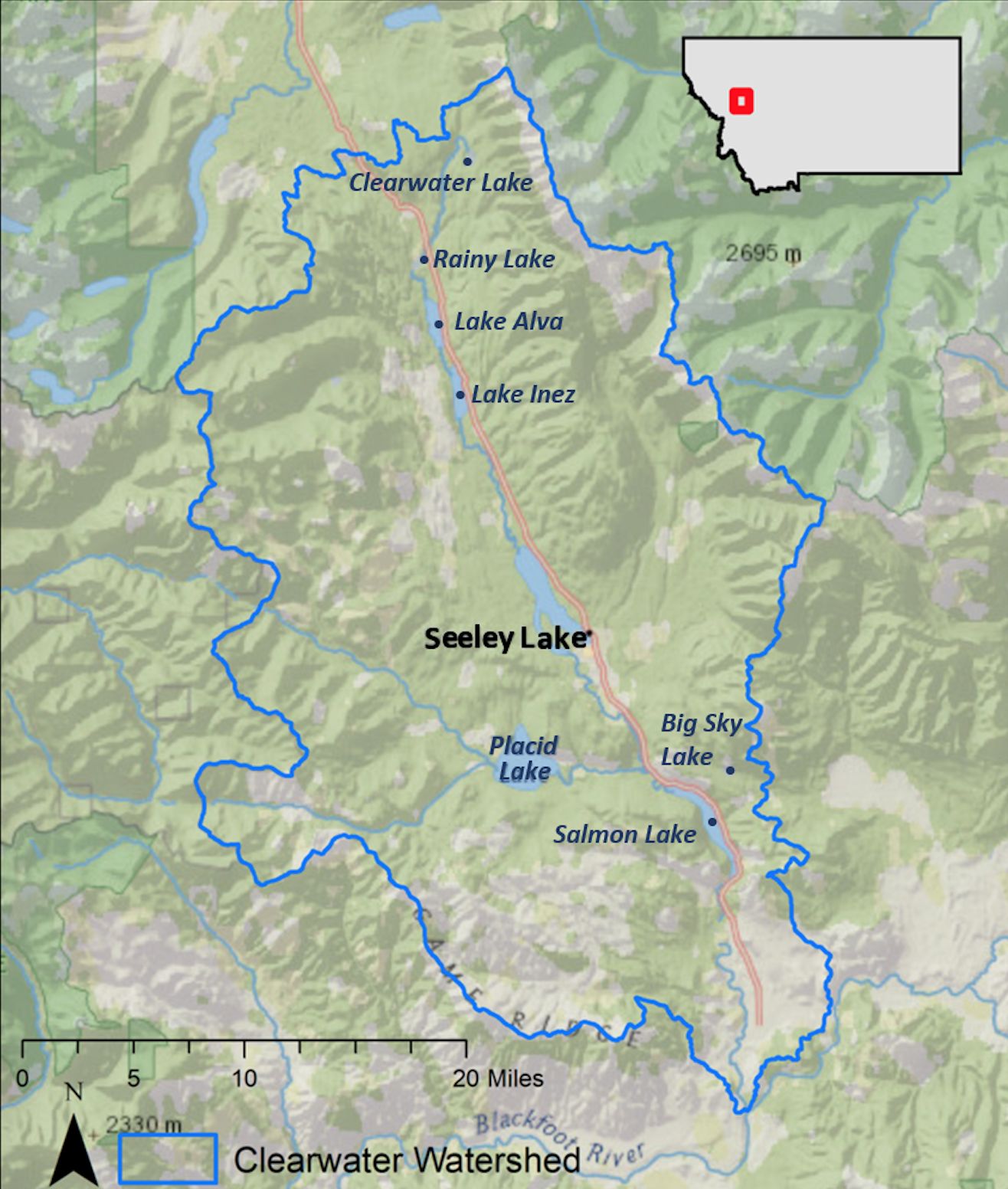
Figure 1: watershed map
The Clearwater Watershed (figure 1) includes a progression of lakes linked together by the Clearwater River, which from north to south include: Clearwater, Rainy, Alva, Inez, Seeley, and Salmon Lakes. Placid Lake and Big Sky Lake feed streams that support Salmon Lake. Eventually the water flows into the Big Blackfoot and Clark Fork rivers.
Monitoring the valley's lakes
Water quality in the Clearwater chain of lakes is integral to all forms of life. These lakes, which dominate the local landscape, form the basis for both a healthy ecosystem and economy (Figure 1). Since 2008, CRC has facilitated efforts to enhance, conserve, sustain, and protect the aquatic resources of the Clearwater Valley for present and future generations.
Among other things, we have worked with residents to:
Keep our lakes safe from invasive species and monitor the overall health of the lakes in the watershed.
Analyze the health of our streams, especially after fires; and
Disseminate resources to enhance your knowledge and appreciation of the lakes in the Clearwater Valley.
However, overall monitoring data is still limited. We are however accumulating more data each year and establishing baseline information regarding water quality as we check lake clarity, record surface temperature and measure various nutrient levels over four months each summer.
The goals associated with monitoring the area lakes include:
Obtain needed baseline data to facilitate sound management decisions and identify emerging trends from year to year.
Initially CRC’s Adopt-a-Lake monitoring program focused solely on temperature and water clarity parameters. Starting in 2020, CRC has measured dissolved oxygen and nutrient analyses on each lake to get a more complete and accurate picture of water quality trends.
Encourage lakeshore property owners to take proactive measures to protect water quality.
Through individual site assessments, CRC has helped property owners identify actions they can take to make their properties more “lake friendly.” Examples include maintaining native vegetative buffers around their property and updating aging septic systems.

Figure 2: values that survey respondents living at Seeley and Placid Lakes deemed most important to life in the Clearwater Valley.
Background: To identify the issues of concern for lakeshore property owners, CRC distributed a survey to residents at Placid and Seeley Lakes in 2019. The survey results indicated that property owners were interested in proactively protecting the health of the lakes upon which they live. It also showed that 100% of survey respondents agreed that they choose to live in the Valley due to the quality of the lake waters and forests, as well as the solitude and tranquility of the region (Figure 2).
Our goal is to understand and protect the values each of us believes makes this valley such a special place for us to live, work, and recreate in. We recognize there are likely some issues we may not be able to solve completely, but acting together we can have a positive impact.
Lake ecology and monitoring terms to know

Figure 3: CRC Adopt-A-Lake volunteers lower the disk on a measuring tape and note the depth when the disk disappears.
Lake ecology encompasses all biotic (living) and abiotic (non-living) components of a lake system including: the water, soil, fish, bugs, nutrients, and microscopic organisms. Degradation of water quality in lakes is associated with accelerated development which can have a profound effect on the natural, aesthetic, and economic benefits associated with lake communities. Monitoring can help us better understand the conditions of our lakes, their vulnerability to change, and the factors associated with water quality degradation.
In 2008, CRC initiated a community-based lake monitoring program. Within the Adopt-a-Lake program citizen scientists measure surface temperature using a floating mercury thermometer and water transparency using a Secchi disk (Figure 3). Transparency is directly influenced by the amount of phytoplankton (microscopic plants or algae) and other individual particles in the water (Figure 4).

Figure 4: Pictured on the left is a eutrophic lake. The lack of water clarity is directly related to the addition of excess nutrients. On the right side is Clearwater Lake (located in our watershed), which is an oligotrophic water body with high clarity.
Much of the organic material that is produced by plants and phytoplankton or transported to the lake by streams within the watershed, ends up in the lake bottom sediments. Some of this organic material decomposes and as it does, it releases stored nutrients (nitrogen and phosphorus ) back into the water. These nutrients, typically different forms of nitrogen and phosphorous, act as fertilizers, which promote aquatic plant and algae growth. The release of nutrients is a normal process in the lifecycle of a lake. However, land use practices can accelerate the nutrient load and cause water quality degradation over time.
More specifically, when nutrient production from plants and phytoplankton is low, lakes are said to be oligotrophic. Oligotrophic lakes are relatively clear, with Secchi depth measurements of 16+ feet (Figure 5).
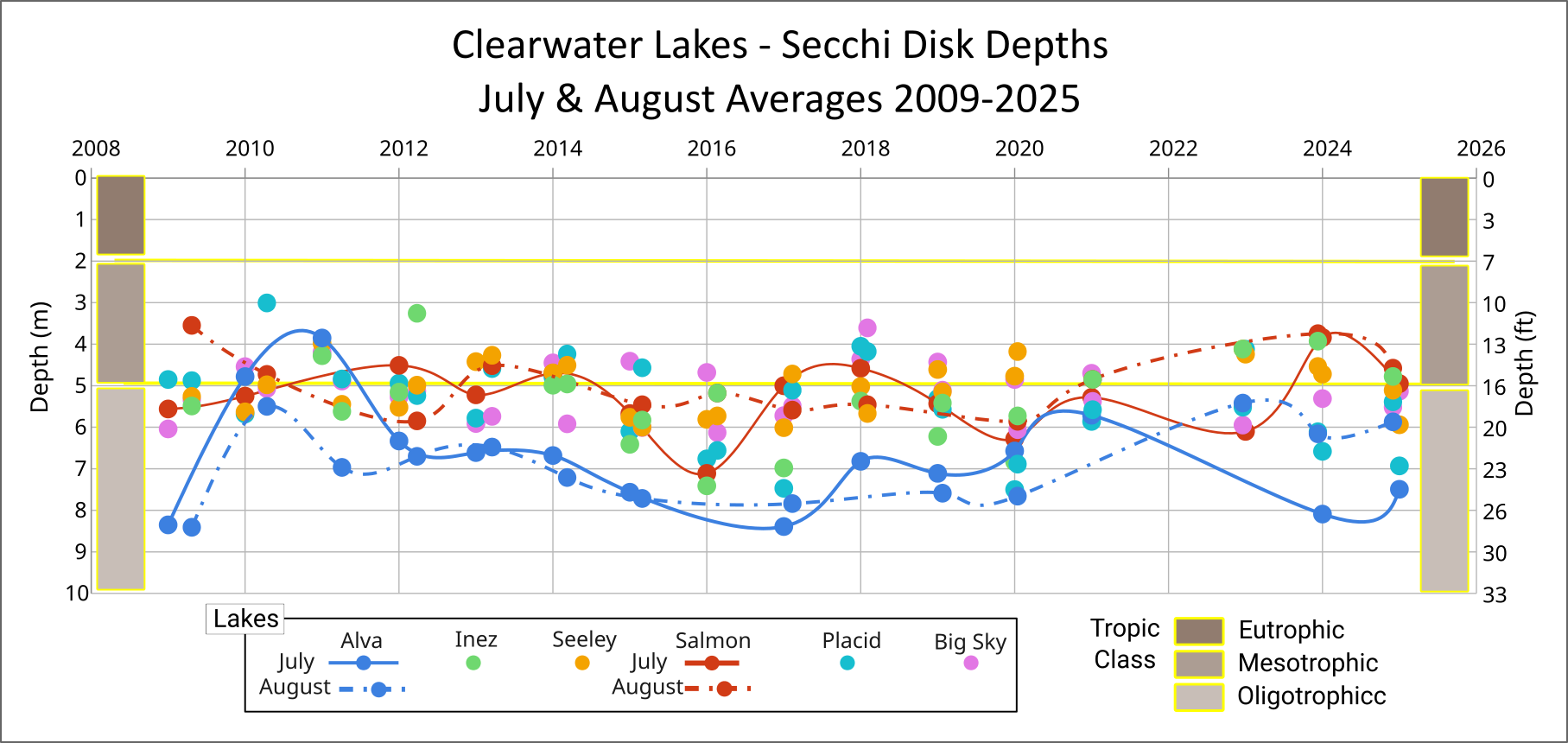
Figure 5: Secchi depths recorded on 6 lake sites in the Clearwater Watershed, during July and August from 2009 through 2025. The red and blue lines reference Lake Alva (near the top of the chain) and Salmon Lake (near the bottom of the chain of lakes). The darker side bars represent the bounds for transparencies considered indicative of eutrophic and oligotrophic conditions, respectively.
Conversely, when the nutrient content of lakes exceeds certain thresholds, plant growth and decomposition increases, with more nutrients being released back into the water. At this point lakes are considered eutrophic and have shallower Secchi depth readings (6.5 feet or less) (Figure 5). Eutrophic lakes have limited oxygen in deep water especially during summer when the lake stratifies (water temperature and density differs greatly from the top to the bottom). Lakes that are in between oligotrophic and eutrophic are typically classified as mesotrophic and have average water clarity.
Many of the lakes in the Valley are oligotrophic and clear, as indicated by the Secchi depths recorded over the past decade (Figure 5). However, as more nutrients are introduced from outside sources, such as fertilizers from lawns and failing septic systems, lakes can become more nutrient productive as a result, and may become eutrophic.
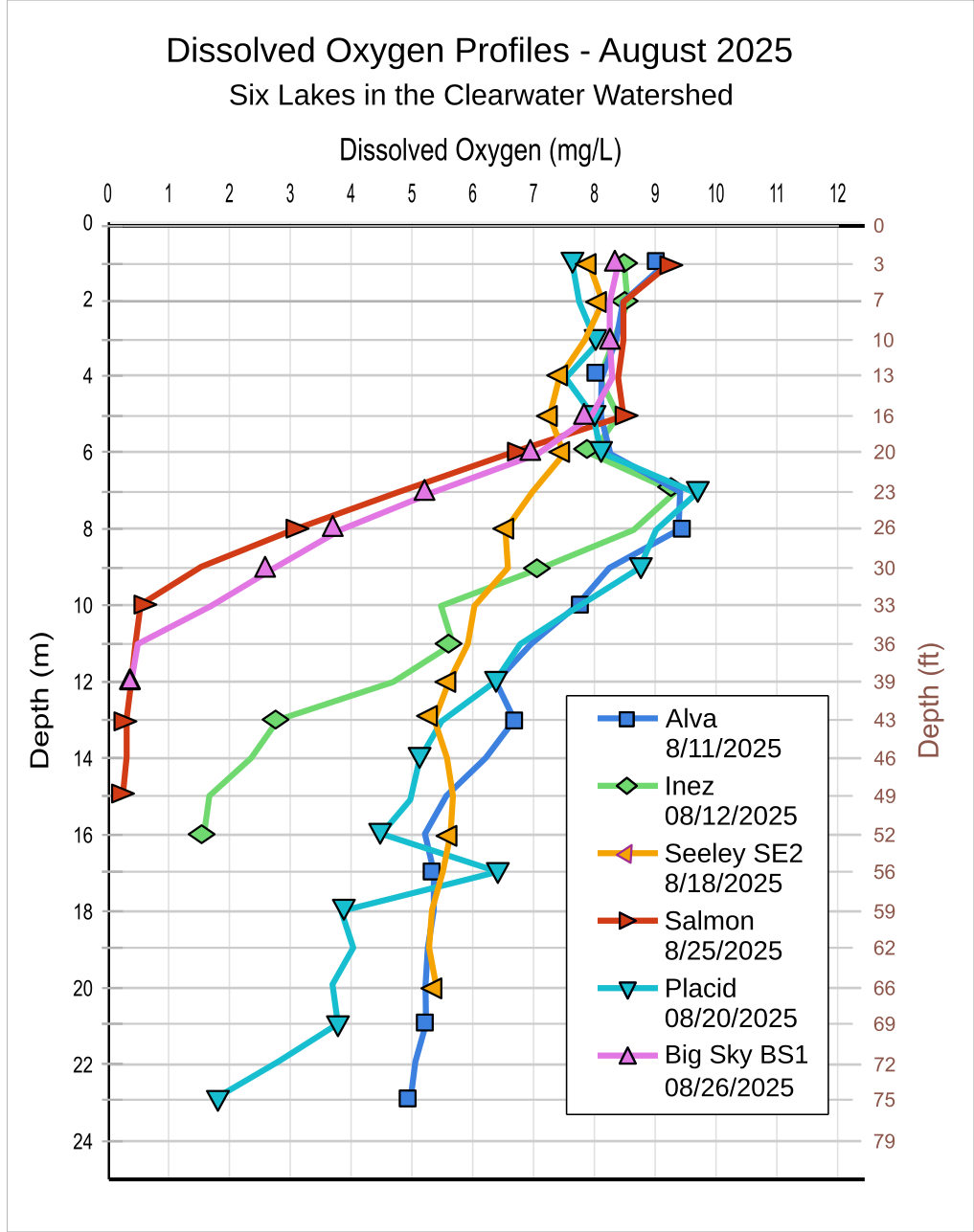
Water clarity measured by Secchi disk readings is directly related to dissolved oxygen (DO), which is a measure of how much oxygen is available to aquatic organisms living in the water. DO in our lakes is used by all forms of aquatic life, which explains why this parameter is typically measured to assess the "health" of lakes and streams.

Views from Lake Alva Adopt-a-Lake monitoring, May 2020. Photo by Emily McGuirt.
Generally, oligotrophic lakes and rapidly moving water (such as mountain streams) remain high in DO concentrations. Conversely, highly productive eutrophic systems and stagnant water are usually oxygen deficient. In addition, in eutrophic systems, an abundance of bacteria often exists, which consume the lake’s organic material and oxygen, and produce carbon dioxide as a byproduct as they respire. In comparison, in oligotrophic systems, DO is plentiful, due in part to the lack of organic material for bacteria to consume.
DO is a biologically important parameter, and all aquatic organisms require it to survive. The amount of DO an animal needs varies, depending on how large or complex it is and where it spends its time in the water column. Benthic or bottom dwelling creatures often require less DO, as they reside in the oxygen deficient muddy lake bottom. However, larger fish need higher DO concentrations, which they “take in” as the water runs over their gills.
DO is also inversely related to water temperature —DO levels are lowest in the summer when water temperature peaks. Conditions may become especially serious during periods of hot, calm weather, resulting in fish kills.
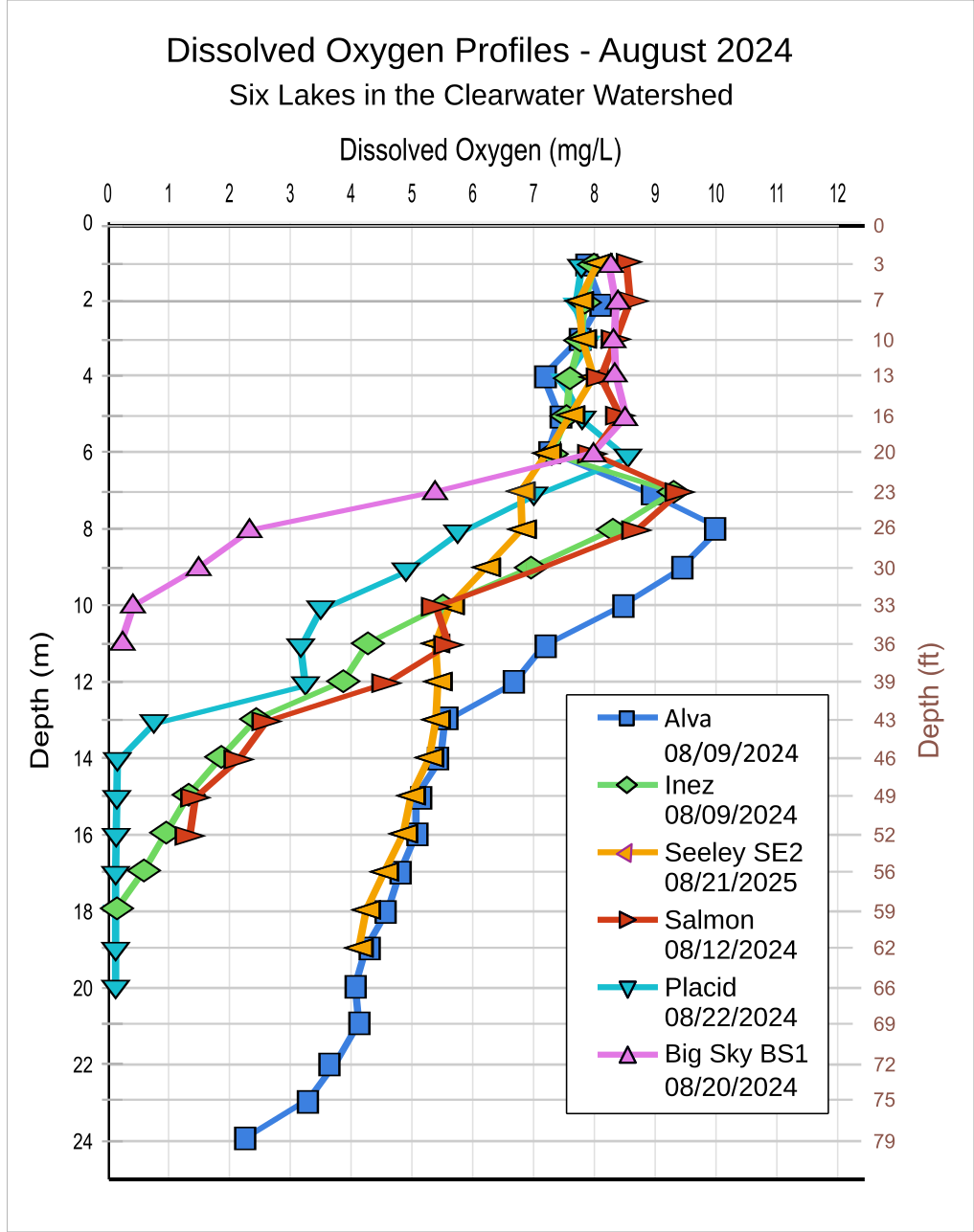
DO profiles have been recorded sporadically on a few of the lakes in the Clearwater over the past few decades, but CRC realized we needed to begin measuring this parameter more consistently, and has been recording both DO at Temperature at depths on the six, “summer monitoring” lakes since 2023.
Click here to learn more about DO.
Click here for a full list of lake ecology terms.
WHAT CAN YOU DO TO HELP?
We as humans add unwanted nutrients to the lakes through our waste, fertilizers, land use practices, etc.
Making sure your home or cabin has an up to date, working septic system can prevent excess nutrients from flowing into the lake.
Allowing native vegetation to grow along your shoreline and reinforcing the bank can prevent sediment from being washed away as boater’s wakes hit the shoreline.
Get involved in any of our various monitoring programs.
Be on the lookout for changing lake conditions, such as harmful algal blooms in the autumn. (Learn more here.) Contact CRC or FWP (at campgrounds if you spot something that is suspect.
Call the CRC Office: 406-677-0069 and leave a message.
learn more about the lakes in our valley!
Special thanks to Emily McGuirt, Alicia Dixon, and most recently Amanda Zelnis who have been CRC’s yearly Big Sky Watershed Corps Member starting in 2020, as well as Haley Yarborough and Teagan Nap who worked the summer of 2022. Their combined efforts in monitoring the valley’s lakes by taking Dissolved Oxygen readings, Secchi Disk recordings and crunching the numbers adds to the overall understanding of the health of these lakes.
Banner Photo: Seeley Lake in Autumn - Jeff Harrits